The Sargent 2-stage function
sargent2stage.RdThis function calculates sample sizes of the Sargent 2-stage design.
The goal of a phase II trial is to make a preliminary determination regarding the activity and
tolerability of a new treatment and thus to determine whether the treatment warrants
further study in the phase III setting.
This function calculates the sample size needed in a Sargent 2-stage design which is a
three-outcome design that allows for three outcomes: reject \(H(0)\), reject \(H(a)\), or reject neither.
sargent2stage(
  p0,
  pa,
  alpha,
  beta,
  eta,
  pi,
  eps = 0,
  N_min,
  N_max,
  int = 0,
  int_window = 0.025,
  CI_type = "Koyama"
)
Arguments
| p0 | probability of the uninteresting response (null hypothesis \(H0\)) |
|---|---|
| pa | probability of the interesting response (alternative hypothesis Ha) |
| alpha | Type I error rate \(P(reject H0|H0)\) |
| beta | Type II error rate \(P(reject Ha|Ha)\) |
| eta | \(P(reject Ha|H0)\) |
| pi | \(P(reject H0|Ha)\) |
| eps | tolerance default value = 0.005 |
| N_min | minimum sample size value for grid search |
| N_max | maximum sample size value for grid search |
| int | pre-specified interim analysis percentage information |
| int_window | window around interim analysis percentage (e.g. 0.5 +- 0.025). 0.025 is default value |
| CI_type | "Koyama", see |
Value
a data.frame with elements
n1: total number of patients in stage1
n2: total number of patients in stage2
N: total number of patients=n1+n2
r1: critical value for the first stage
r2: critical value for the second stage
eff: s/N
CI_LL: (1-2*alpha) CI lower limit
CI_UL: (1-2*alpha) CI upper limit
EN.p0: expected sample size under H0
PET.p0: probability of terminating the trial at the end of the first stage under H0
MIN: column indicating if the design is the minimal design
OPT: column indicating if the setting is the optimal design
ADMISS: column indicating if the setting is the admissible design
alpha: the actual alpha value which is smaller than
alpha_param + epsbeta: the actual beta value where which is smaller than
beta_param + epseta: the actual eta value which is smaller than
eta_param - epspi: the actual pi value which is smaller than
pi_param - epslambda: 1-(eta+alpha)
delta: 1-(beta+pi)
p0: your provided
p0valuepa: your provided
pavaluealpha_param: your provided
alphavaluebeta_param: your provided
betavalueeta_param: your provided
etavaluepi_param: your provided
pivalue
Details
if x1<=r1 --> stop futility
if (x1+x2)<=r --> futility
if (x1+x2)>=s --> efficacy
References
Sargent DJ, Chan V, Goldberg RM. A three-outcome design for phase II clinical trials. Control Clin Trials. 2001;22(2):117-125. doi:10.1016/s0197-2456(00)00115-x
Examples
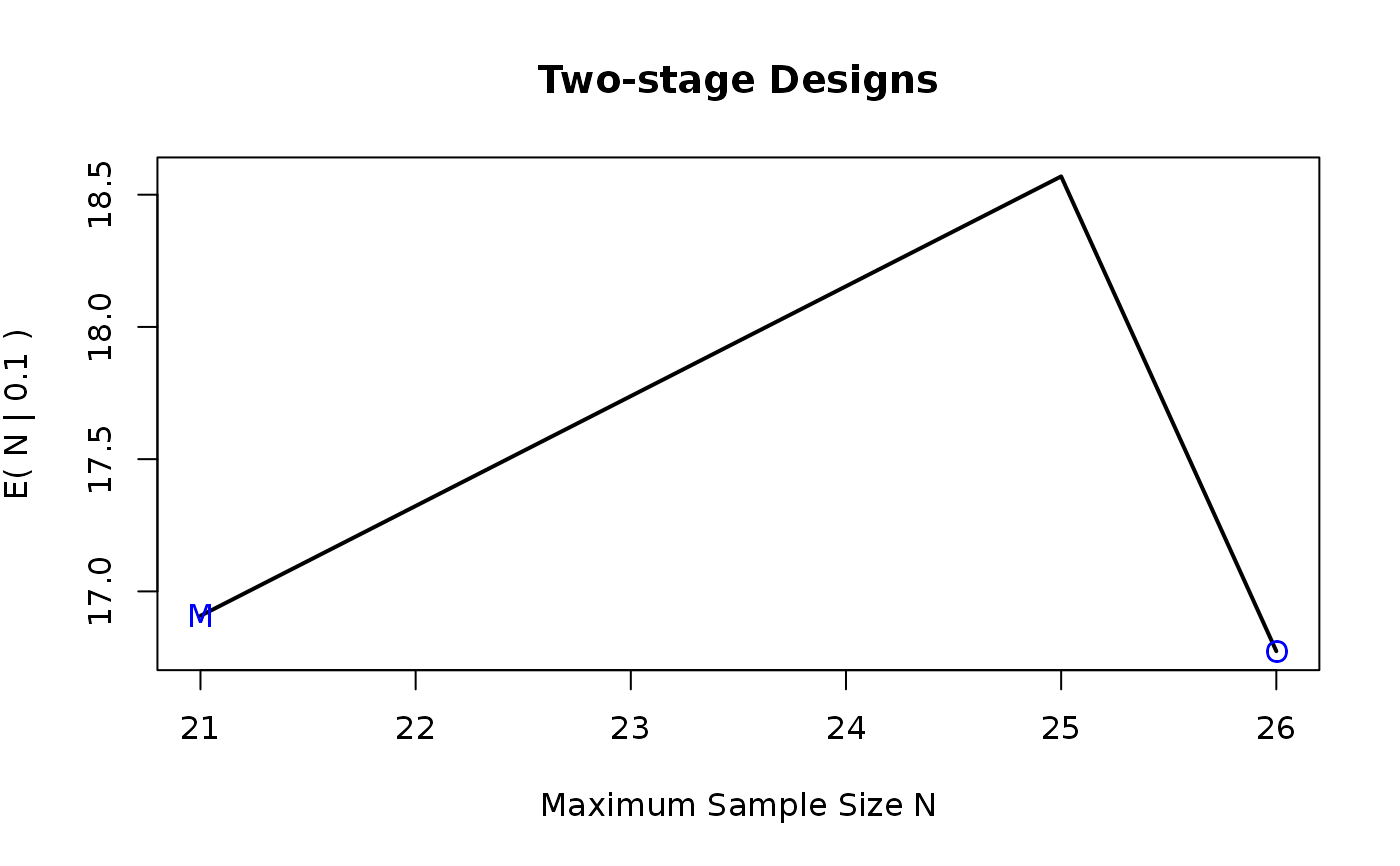
samplesize <- sargent2stage(p0 = 0.1, pa = 0.3, alpha = 0.05, beta = 0.1, eta = 0.8, pi = 0.8,
eps = 0.005, N_min = 15, N_max = 30)
plot(samplesize)
 # \donttest{
data(data_sargent2)
test <- data_sargent2
samplesize <- sargent2stage(p0 = test$p0, pa = test$pa, alpha = test$alpha, beta = test$beta,
eta = test$eta, pi = test$pi,
eps = 0.005,
N_min = test$N_min, N_max = test$N_max)
optimal <- lapply(samplesize, FUN=function(x) subset(x, OPT == "Optimal"))
optimal <- data.table::rbindlist(optimal)
#> Column 9 ['90%CI_LL'] of item 2 is missing in item 1. Use fill=TRUE to fill with NA (NULL for list columns), or use.names=FALSE to ignore column names. use.names='check' (default from v1.12.2) emits this message and proceeds as if use.names=FALSE for backwards compatibility. See news item 5 in v1.12.2 for options to control this message.
minimax <- lapply(samplesize, FUN=function(x) subset(x, MIN == "Minimax"))
minimax <- data.table::rbindlist(minimax)
#> Column 9 ['90%CI_LL'] of item 2 is missing in item 1. Use fill=TRUE to fill with NA (NULL for list columns), or use.names=FALSE to ignore column names. use.names='check' (default from v1.12.2) emits this message and proceeds as if use.names=FALSE for backwards compatibility. See news item 5 in v1.12.2 for options to control this message.
# }
# \donttest{
data(data_sargent2)
test <- data_sargent2
samplesize <- sargent2stage(p0 = test$p0, pa = test$pa, alpha = test$alpha, beta = test$beta,
eta = test$eta, pi = test$pi,
eps = 0.005,
N_min = test$N_min, N_max = test$N_max)
optimal <- lapply(samplesize, FUN=function(x) subset(x, OPT == "Optimal"))
optimal <- data.table::rbindlist(optimal)
#> Column 9 ['90%CI_LL'] of item 2 is missing in item 1. Use fill=TRUE to fill with NA (NULL for list columns), or use.names=FALSE to ignore column names. use.names='check' (default from v1.12.2) emits this message and proceeds as if use.names=FALSE for backwards compatibility. See news item 5 in v1.12.2 for options to control this message.
minimax <- lapply(samplesize, FUN=function(x) subset(x, MIN == "Minimax"))
minimax <- data.table::rbindlist(minimax)
#> Column 9 ['90%CI_LL'] of item 2 is missing in item 1. Use fill=TRUE to fill with NA (NULL for list columns), or use.names=FALSE to ignore column names. use.names='check' (default from v1.12.2) emits this message and proceeds as if use.names=FALSE for backwards compatibility. See news item 5 in v1.12.2 for options to control this message.
# }