Simon 2-stage function
simon2stage.RdThe primary objective of a phase II clinical trial of a new drug or regimen is to determine whether it has sufficient biological activity
against the disease under study to warrant more extensive development.
This function calculates the sample size needed in a Simon 2-stage design which is a
two-stage design that is optimal in the sense that the expected sample size is minimized if the
regimen has low activity subject to constraints upon the size of the type 1 and type 2 errors.
Two-stage designs which minimize the maximum sample size are also determined.
simon2stage(
  p0,
  pa,
  alpha,
  beta,
  eps = 0,
  N_min,
  N_max,
  int = 0,
  int_window = 0.025,
  CI_type = "Koyama"
)
Arguments
| p0 | probability of the uninteresting response (null hypothesis \(H0\)) |
|---|---|
| pa | probability of the interesting response (alternative hypothesis Ha) |
| alpha | Type I error rate \(P(reject H0|H0)\) |
| beta | Type II error rate \(P(reject Ha|Ha)\) |
| eps | tolerance default value = 0.005 |
| N_min | minimum sample size value for grid search |
| N_max | maximum sample size value for grid search |
| int | pre-specified interim analysis percentage information |
| int_window | window around interim analysis percentage (e.g. 0.5 +- 0.025). 0.025 is default value |
| CI_type | "Koyama", see |
Value
a data.frame with elements
n1: total number of patients in stage1
n2: total number of patients in stage2
N: total number of patients=n1+n2
r1: threshold for "rejecting" Ha: if x1<=r1 --> stop for futility at first stage
r2: threshold for "rejecting" Ha: if x1+x2<=r2 --> futility at second stage
eff: (r2 + 1)/N
CI_LL: (1-2*alpha) CI lower limit
CI_UL: (1-2*alpha) CI upper limit
EN.p0: expected sample size under H0
PET.p0: probability of terminating the trial at the end of the first stage under H0
MIN: column indicating if the design is the minimal design
OPT: column indicating if the setting is the optimal design
ADMISS: column indicating if the setting is the admissible design
alpha: the actual alpha value which is smaller than
alpha_param + epsbeta: the actual beta value where which is smaller than
beta_param + epsp0: your provided
p0valuepa: your provided
pavaluealpha_param: your provided
alphavaluebeta_param: your provided
betavalue
Details
if x1<=r1 --> stop futility
if (x1+x2)<=r2 --> futility
if (x1+x2)> r2 --> efficacy
References
Simon R. Optimal two-stage designs for phase II clinical trials. Control Clin Trials. 1989;10(1):1-10. doi:10.1016/0197-2456(89)90015-9 Koyama T, Chen H. Proper inference from simon’s two-stage designs. Stat Med. 2008; 27:3145–154;
Examples
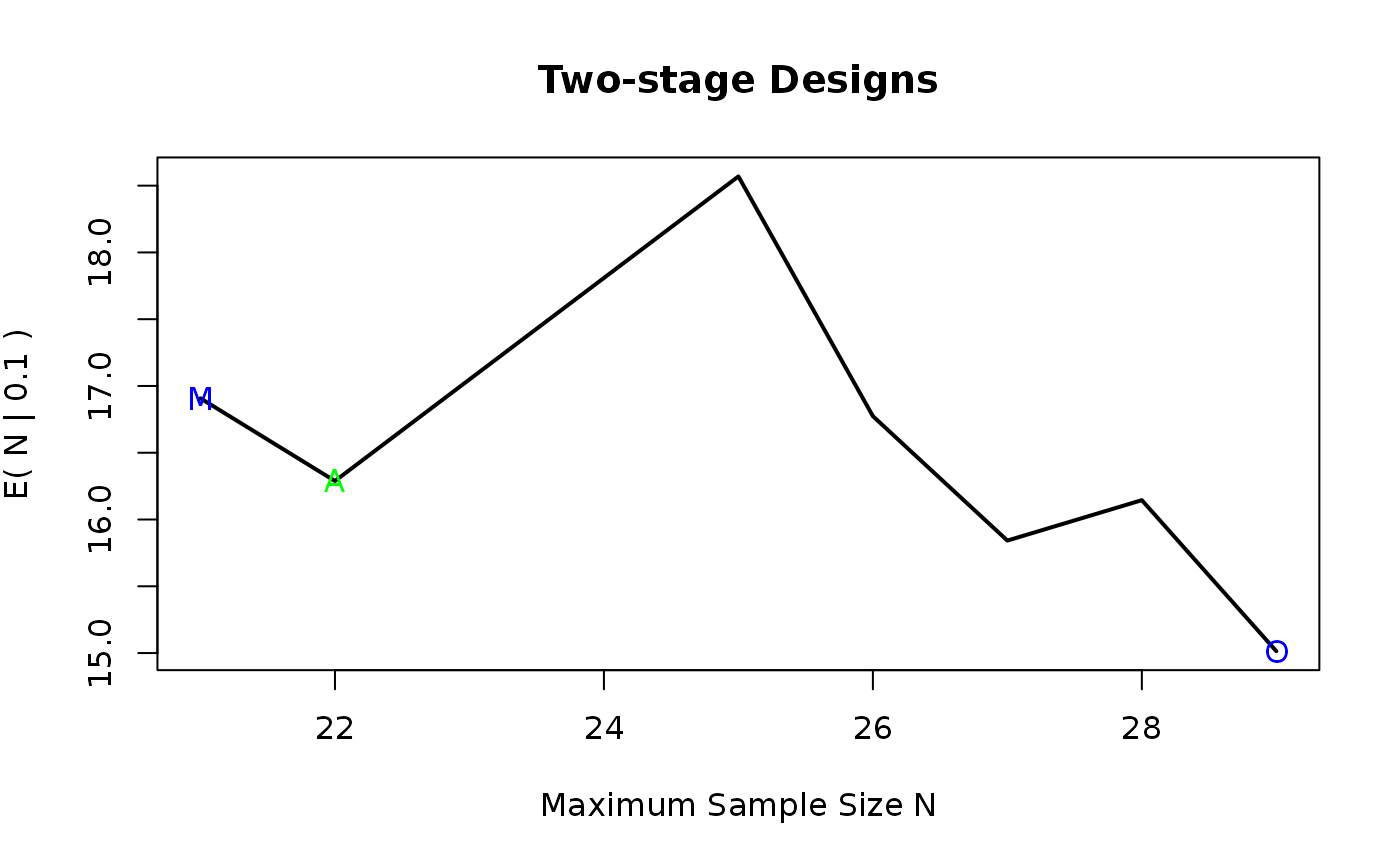
samplesize <- simon2stage(p0 = 0.1, pa = 0.3, alpha = 0.05, beta = 0.2,
eps = 0.005, N_min = 1, N_max = 50)
plot(samplesize)
 # \donttest{
samplesize <- simon2stage(p0 = 0.1, pa = 0.3, alpha = 0.05, beta = 0.2,
eps = 0.005, N_min = 1, N_max = 50,int=0.33,int_window=0.025)
plot(samplesize)
# \donttest{
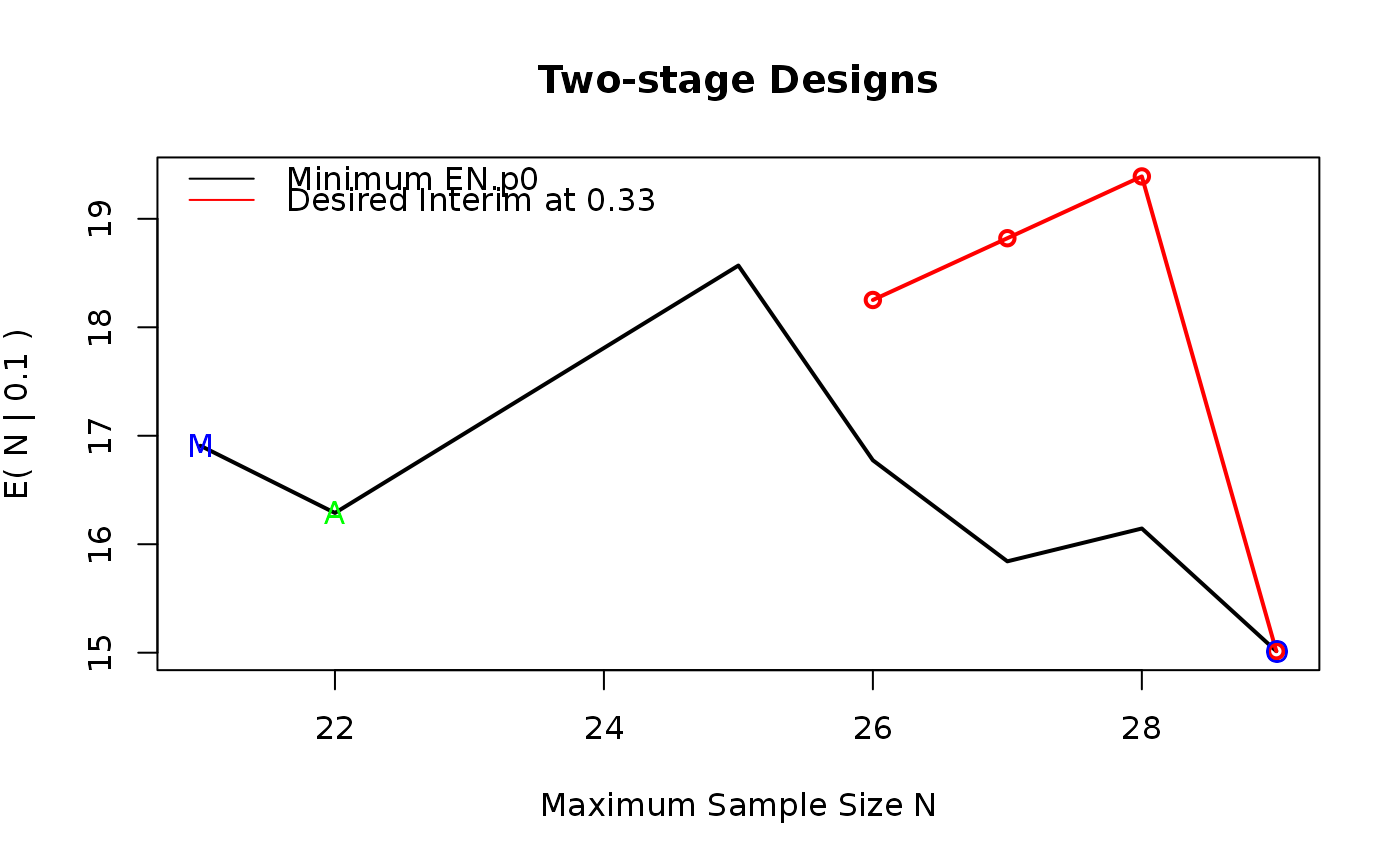
samplesize <- simon2stage(p0 = 0.1, pa = 0.3, alpha = 0.05, beta = 0.2,
eps = 0.005, N_min = 1, N_max = 50,int=0.33,int_window=0.025)
plot(samplesize)
 # }
# \donttest{
## Example 1
test <- data.frame(p0 = c(0.05, 0.1, 0.2, 0.3, 0.4, 0.5, 0.6, 0.7),
pa = c(0.05, 0.1, 0.2, 0.3, 0.4, 0.5, 0.6, 0.7) + 0.2)
test <- merge(test,
data.frame(alpha = c(0.1, 0.05, 0.05), beta = c(0.1, 0.2, 0.1)))
samplesize <- fleming1stage(p0 = test$p0, pa = test$pa, alpha = test$alpha, beta = test$beta)
samplesize <- simon2stage(p0 = test$p0, pa = test$pa, alpha = test$alpha, beta = test$beta,
N_min = 10, N_max = samplesize$N + 15)
optimal_minimax <- lapply(samplesize, FUN=function(x){
cbind(subset(x, OPT == "Optimal", c("r1","n1","r2","N","EN.p0","PET.p0")),
subset(x, MIN == "Minimax", c("r1","n1","r2","N","EN.p0","PET.p0")))
})
optimal_minimax <- data.table::rbindlist(optimal_minimax)
## Example 2
test <- data.frame(p0 = c(0.05, 0.1, 0.2, 0.3, 0.4, 0.5, 0.6, 0.7),
pa = c(0.05, 0.1, 0.2, 0.3, 0.4, 0.5, 0.6, 0.7) + 0.15)
test <- merge(test,
data.frame(alpha = c(0.1, 0.05, 0.05), beta = c(0.1, 0.2, 0.1)))
samplesize <- fleming1stage(p0 = test$p0, pa = test$pa, alpha = test$alpha, beta = test$beta)
samplesize <- simon2stage(p0 = test$p0, pa = test$pa, alpha = test$alpha, beta = test$beta,
N_min = 25, N_max = samplesize$N + 20)
optimal_minimax <- lapply(samplesize, FUN=function(x){
cbind(subset(x, OPT == "Optimal", c("r1","n1","r2","N","EN.p0","PET.p0")),
subset(x, MIN == "Minimax", c("r1","n1","r2","N","EN.p0","PET.p0")))
})
optimal_minimax <- data.table::rbindlist(optimal_minimax)
# }
# }
# \donttest{
## Example 1
test <- data.frame(p0 = c(0.05, 0.1, 0.2, 0.3, 0.4, 0.5, 0.6, 0.7),
pa = c(0.05, 0.1, 0.2, 0.3, 0.4, 0.5, 0.6, 0.7) + 0.2)
test <- merge(test,
data.frame(alpha = c(0.1, 0.05, 0.05), beta = c(0.1, 0.2, 0.1)))
samplesize <- fleming1stage(p0 = test$p0, pa = test$pa, alpha = test$alpha, beta = test$beta)
samplesize <- simon2stage(p0 = test$p0, pa = test$pa, alpha = test$alpha, beta = test$beta,
N_min = 10, N_max = samplesize$N + 15)
optimal_minimax <- lapply(samplesize, FUN=function(x){
cbind(subset(x, OPT == "Optimal", c("r1","n1","r2","N","EN.p0","PET.p0")),
subset(x, MIN == "Minimax", c("r1","n1","r2","N","EN.p0","PET.p0")))
})
optimal_minimax <- data.table::rbindlist(optimal_minimax)
## Example 2
test <- data.frame(p0 = c(0.05, 0.1, 0.2, 0.3, 0.4, 0.5, 0.6, 0.7),
pa = c(0.05, 0.1, 0.2, 0.3, 0.4, 0.5, 0.6, 0.7) + 0.15)
test <- merge(test,
data.frame(alpha = c(0.1, 0.05, 0.05), beta = c(0.1, 0.2, 0.1)))
samplesize <- fleming1stage(p0 = test$p0, pa = test$pa, alpha = test$alpha, beta = test$beta)
samplesize <- simon2stage(p0 = test$p0, pa = test$pa, alpha = test$alpha, beta = test$beta,
N_min = 25, N_max = samplesize$N + 20)
optimal_minimax <- lapply(samplesize, FUN=function(x){
cbind(subset(x, OPT == "Optimal", c("r1","n1","r2","N","EN.p0","PET.p0")),
subset(x, MIN == "Minimax", c("r1","n1","r2","N","EN.p0","PET.p0")))
})
optimal_minimax <- data.table::rbindlist(optimal_minimax)
# }